REVIEW · RIO DE JANEIRO
Rio de Janeiro Tour – Discover Christ the Redeemer and the Marvelous City
Book on Viator →Operated by Brasil Show Turismo - Agência de Turismo Rio de Janeiro · Bookable on Viator
One hill in Rio sets the tone fast. This 5-hour tour strings together the big icons and the everyday textures of Rio de Janeiro, starting with Christ the Redeemer and rolling through neighborhoods, monuments, and viewpoints. What I like most is how guides like Márcio bring the sites to life with clear explanations in Spanish and Portuguese. One thing to plan for: the schedule is tight, and the tour can feel strict about timing once you’re at the top sights.
I also love the practical value here: the route packs in several major stops—Corcovado, Selarón Steps, the Sambadrome area, a famous cathedral, Tijuca Forest, and Maracanã—without making you hunt for separate tickets. Each featured stop lists admission ticket free, so you’re mostly paying for the route, coordination, and guiding rather than overhead.
The possible drawback is simple: if the group runs late, you’ll likely feel it. Several guide moments in Rio tours come down to punctuality, and at Christ the Redeemer you should assume you won’t have long to linger for photos once you’re inside the allowed time window.
In This Review
- Quick hits before you go
- How this Rio combo tour fits a real itinerary day
- Corcovado and Christ the Redeemer: what to expect from your time up top
- Escadaria Selarón: the quickest stop that still feels personal
- The Sambadrome stop: Carnival’s stage, even when it’s quiet
- Catedral Metropolitana do Rio: a modern cathedral built for stained glass
- Tijuca Forest’s quick breath: history of reforestation in the city
- Maracanã and the beach drive: closing with Rio’s big energy
- Price and value: what $90 buys you in a 5-hour plan
- Guide quality matters: Márcio, Lucas, and Gisel as real signals
- The main watch-outs: punctuality, language expectations, and crowds at the top
- Who should book this tour, and who might want something else
- Should you book this Rio highlights tour?
- FAQ
- How long is the Rio de Janeiro Discover Christ and the city tour?
- What time does the tour start?
- How much does the tour cost?
- What sights are included in the tour?
- Are admission tickets included for the stops?
- How big is the group?
- What meeting point setup should I expect?
- Does the tour depend on weather?
- Can I cancel for a refund?
- On average, how far in advance do people book?
Quick hits before you go

- Christ the Redeemer on Corcovado gives you a panoramic Rio overview, but the on-site window can feel short, so be ready when you arrive.
- Escadaria Selarón is a quick, free, photo-friendly stop between Santa Teresa and Lapa, finished with the story of Jorge Selarón’s tribute.
- Sambadrome da Marquês de Sapucaí lets you see the Carnival parade stage even if you’re not visiting in February.
- Catedral Metropolitana (conical shape) is big, modern, and designed to make colored stained glass the star.
- Floresta da Tijuca offers a rare dose of major urban forest history in just about 10 minutes.
- Small group size (max 19) helps the day feel controlled, as long as everyone keeps to the schedule.
How this Rio combo tour fits a real itinerary day

Rio can be overwhelming. One day you’re thinking beaches, the next you’re thinking mountains, and the next you’re trying to remember where you even parked. This tour is built like a shortcut through the city’s biggest “first-time Rio” hits, starting at 8:00 am and running about 5 hours.
The route also mixes iconic landmarks with places that explain how Rio feels day to day. You’re not only looking at monuments—you’re moving between different neighborhood vibes and city functions. That matters because Rio is not one theme. It’s a set of different Rio’s.
And yes, the group size cap of 19 helps. Smaller groups usually mean fewer headaches at meeting points and smoother movement on busy streets. Still, your experience depends on group punctuality, since there are multiple short stops.
You can also read our reviews of more city tours in Rio de Janeiro



Corcovado and Christ the Redeemer: what to expect from your time up top

Corcovado is one of Rio’s famed hills, and Christ the Redeemer is the reason people go. The statue is 38 meters high, and from here you get the panoramic city view that most photos are trying to capture.
What I think you should take seriously is time at the top. In this kind of schedule, the visit can be brief—one review-style detail you should plan around is about 40 minutes at Christ—which means you need a simple photo plan before you walk in. Pick where you want your main skyline shot, then take your second shot fast.
Practical tip: go in knowing that Corcovado can be crowded. If you’re waiting for a perfect photo moment, you’ll slow yourself down and you’ll probably feel rushed. Instead, aim for quick, solid shots, then spend your remaining minutes just looking. The city view is the point.
Also, the tour structure here means Corcovado happens early enough to catch the day before it gets too hot and crowded. That’s a real advantage in Rio. Waiting around in the sun in the mid-morning will drain your energy.
Escadaria Selarón: the quickest stop that still feels personal

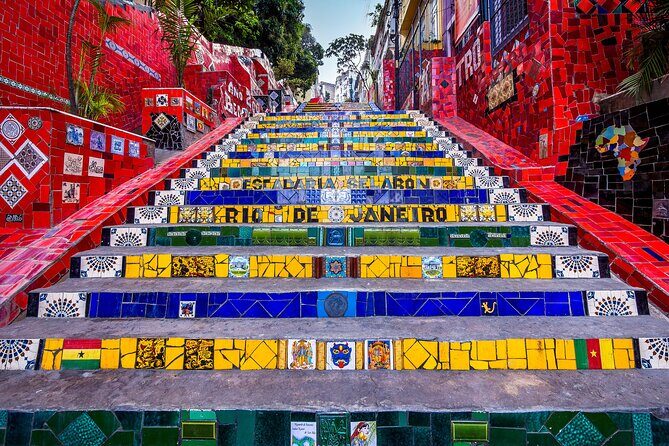
After Corcovado, the day cools down visually with a colorful street art stop: Escadaria Selarón. These stairs sit between the neighborhoods of Santa Teresa and Lapa, and they’re decorated by the Chilean artist Jorge Selarón as a tribute to the Brazilian people.
This is one of those stops that’s short on paper—about 20 minutes—but long on impact. You’ll see the mosaics up close, notice how the colors shift depending on where you stand, and get a break from the big monument scale of Corcovado.
The best use of your time is to treat it like a photo walk. Don’t try to do it like a museum. Step, angle, shoot, then move up or down to find another perspective. The stairs are designed for that.
If you’re the type who likes architecture and street-level design, this stop will feel like a gift. It’s Rio showing you how art becomes part of the sidewalk.
The Sambadrome stop: Carnival’s stage, even when it’s quiet
Next up is the Sambadromo da Marquês de Sapucaí (also known as Passarela Professor Darcy Ribeiro). Even if you’re not visiting during Carnival, it’s worth seeing because you can still understand the scale and the drama of the parade setting.
This stop is about 20 minutes and lists admission ticket free. The real value is not shopping or wandering for hours—it’s getting the sense of the venue, the layout, and why it’s the stage for the parade of the samba schools held annually during Carnival.
If you’re a first-timer, this is a smart addition. Most people think they need to be in Rio during the big holiday to appreciate Carnival culture. You don’t. You just need to see the place where it happens, then imagine the energy.
Catedral Metropolitana do Rio: a modern cathedral built for stained glass
One of the more surprising stops is the Catedral Presbiteriana Do Rio de Janeiro, listed in the tour details as the Cathedral of São Sebastião do Rio de Janeiro and also known as the Metropolitan Cathedral of Rio de Janeiro.
You’re walking into a modern design with a distinctive conical shape. It’s inaugurated in 1979, and the stained glass is a major feature: colored panels cover the walls up to the dome. The listed capacity is enormous—20,000 people standing.
This stop is about 30 minutes, also showing admission ticket free. That’s plenty of time to appreciate the structure from outside, then take a slow look inside.
What I like about this stop is that it adds balance. Rio’s big sights often lean toward mountains and beaches. This gives you a human-made spiritual scale and a different kind of atmosphere—straight lines, light, and color patterns that feel designed, not accidental.
If you’re sensitive to crowds, this might still be busy depending on the day, but it tends to feel more “contained” than Corcovado.






Tijuca Forest’s quick breath: history of reforestation in the city

After the cathedral, the tour heads to Floresta da Tijuca, one of the largest urban forests in the world. This forest was created in 1861 by Emperor Pedro II after deforestation from sugarcane and coffee cultivation.
Your stop here is short—about 10 minutes—but it can reset your senses. It’s the kind of place where you feel the climate shift immediately compared with the city streets.
Don’t expect a hike at this stop; the tour time is too short for that. Instead, treat it like a breathing break and a visual reminder that Rio isn’t only concrete and coastline. It has serious green areas right inside the city.
If you’re traveling during hotter months, this pause can help you stay fresh for the last part of the tour.
Maracanã and the beach drive: closing with Rio’s big energy
The final named stop is Maracanã—officially Estádio Jornalista Mário Filho, often called Maracanã. The tour lists it as being in Rio’s North Zone and gives you about 20 minutes.
This isn’t a deep stadium tour with a long walkthrough. It’s more like a look-and-absorb stop. Still, Maracanã matters. It’s one of Brazil’s most famous football stadiums, and even if you’re not a sports superfan, the scale and atmosphere tend to get your attention.
Between stops, the tour also mentions a comfortable vehicle ride to see Rio’s beaches. That piece is easy to underestimate. In a short tour day, you might not have time to sit on the sand, but you can still catch the coastline feel from the road and connect it to the city views you got earlier.
That combo—forest break, stadium energy, coastal glimpses—helps Rio feel like a whole place rather than a set of disconnected photos.
Price and value: what $90 buys you in a 5-hour plan
At $90 per person for about 5 hours, this tour sits in the “solid value” category if you care about first-time highlights without building a DIY route.
Here’s why it feels worth it for many people:
- Multiple major sights in one day means fewer transport decisions and less planning stress.
- The listed admission tickets are free for the featured stops, so you’re not paying extra at each location for entry fees.
- The max 19 traveler group size is small enough to keep things from feeling like a cattle call.
The “price caution” is about time quality. When schedules tighten, you don’t get more time by paying more. You only get the same fixed route. If you’re the type who likes long museum-style visits, this may feel fast. If you’re the type who wants a strong overview and then returns later on your own, this price makes a lot of sense.
Also, you’ll get the most out of this tour if you travel light and keep your head in the day. The itinerary is designed to move.
Guide quality matters: Márcio, Lucas, and Gisel as real signals
One of the strongest themes from the experience is guide performance. Names come up repeatedly: Márcio is often singled out for being friendly, knowledgeable, and able to explain things in Portuguese and Spanish. In several accounts, his explanations were described as clear and full of local context.
Lucas also appears as a guide name and is described as okay but not as standout. Another guide name, Gisel, is mentioned with praise for punctual, attentive service and Spanish.
Here’s the practical takeaway: the tour’s core sights are fixed, but your day feel depends heavily on the guide’s pacing and attitude. If you want the best experience, aim to choose a departure date that aligns with good weather (this experience requires good conditions) and shows up on time.
And when you’re at the stops, don’t wait for a long debate or a slow group. If the group’s schedule is working, guides tend to make the time count.
The main watch-outs: punctuality, language expectations, and crowds at the top
The tour includes multiple short stops. That format leaves little margin for delays. One downside that shows up is the feeling of waiting when other people don’t keep to the meeting time. If you’re easygoing, you’ll still feel it. If you’re strict about timing, you’ll feel it more.
The Corcovado portion is where you’ll most likely notice the pressure. Crowds build, and the allowed time at the top can feel tight. If you show up late or miss the moment your group is ready to move, you’ll lose time immediately.
Language is another consideration. Some guides have Spanish and Portuguese strengths, and in at least one experience the guide indicated they would run in Spanish for that group, with English explanations depending on someone asking. If you want English specifically, plan to confirm that expectation in advance.
Finally, weather matters. This tour needs good weather. If clouds roll in over Corcovado, your view quality can drop, and the operator may adjust the day.
Who should book this tour, and who might want something else
This is a great fit if you want a first-timer Rio overview with minimal planning. You’ll like it if you enjoy getting your bearings fast: one day, many icons, and a real sense of where things sit.
It’s also a good choice for people who don’t want to spend hours on transport or researching separate tickets. Because several entries are listed as free, you’ll feel the money goes toward time and coordination rather than constant add-ons.
You might consider a different style of tour if you hate rushed stops or if you need long stays for photos and wandering. This route moves, and a lot of places are short by design.
Also, if you’re traveling with anyone who gets anxious about waiting, keep that in mind. The tour’s success depends on everyone syncing up.
Should you book this Rio highlights tour?
I’d book it if you want a strong Christ the Redeemer + city icons day that saves you from planning. It’s especially good value when you’re happy with shorter visits and you trust a guide to give you context quickly.
I’d skip it if you’re the type who needs long, unhurried time at each stop or if punctuality stress ruins the day. In that case, you might prefer a slower tour or a self-guided plan that gives you breathing room.
If you do book, show up early, be ready for crowds at Corcovado, and treat the day as an overview you’ll build on later.
FAQ
How long is the Rio de Janeiro Discover Christ and the city tour?
It runs for about 5 hours (approx.).
What time does the tour start?
The start time is 8:00 am.
How much does the tour cost?
The price is $90.00 per person.
What sights are included in the tour?
The tour includes Christ the Redeemer (Corcovado), Escadaria Selarón, a drive to see Rio’s beaches, Sambodromo da Marquês de Sapucaí, Catedral Presbiteriana do Rio de Janeiro (Metropolitan Cathedral), Floresta da Tijuca, and Maracanã.
Are admission tickets included for the stops?
The tour details list admission ticket free for the featured stops.
How big is the group?
The maximum group size is 19 travelers.
What meeting point setup should I expect?
The meeting point is near public transportation.
Does the tour depend on weather?
Yes. This experience requires good weather, and if it’s canceled due to poor weather you’ll be offered a different date or a full refund.
Can I cancel for a refund?
Yes. Free cancellation is available if you cancel at least 24 hours in advance for a full refund.
On average, how far in advance do people book?
On average, it’s booked 9 days in advance.