REVIEW · SANTOS
7-Hour Shared Group Santos Tour : Mont Serrat, Coffee Museum and Sightseeing
Book on Viator →Operated by Gregtur Turismo · Bookable on Viator
Santos has a full-day story you can walk. This 7-hour shared group tour strings together historic Santos, long beach views, hilltop panoramas, and two big indoor stops, with pickup at the Santos Seaport and a max group size of 15. It’s a tight schedule, but it’s the kind that gives you a real sense of the city in one go, not just a drive-by.
Two things I like a lot: the mix of outdoor viewpoints (like Porchat Island and Monte Serrat) plus culture stops (Pelé and coffee), and the way the day is built around included admission tickets so you’re not hunting for venues. I also appreciate that you’re riding with small groups and a driver-guide setup designed for getting everyone back on time.
One thing to consider: with a packed route, some stops feel short, and lunch is on your own. If you’re the type who wants a long, unhurried beach break, plan to use the photo moments well and save extra time for later on your own. (Also, sound system issues can happen in rare cases—sit where you can hear clearly.)
In This Review
- Key reasons this Santos tour works
- Entering Santos: historic center and the long Beach Garden walk
- Porchat Island: Niemeyer’s monument viewpoint and port horizons
- Orquidário Municipal: the urban tropical forest walk that surprises people
- Lunch time on your own: how to use that hour best
- Monte Serrat: funicular ride up, panorama down, chapel built in 1603
- Museu Pelé: football glory, but grounded in Santos
- Valongo Sanctuary + Coffee Museum: from old faith to the smell of Brazilian coffee
- Your 7-hour time budget: what fits, what doesn’t
- Price and value: is $89 a fair deal for this Santos mix?
- The guide experience: clear English and timing that protects your day
- Who should book this Santos shared group tour?
- Should you book this Santos tour?
- FAQ
- What’s included in the 7-hour Santos tour?
- Is lunch included?
- How big is the group?
- Where does the tour start and what time does it begin?
- How long is the tour?
- What happens if it rains?
Key reasons this Santos tour works
- Max 15 travelers so the day doesn’t feel like a cattle-car version of sightseeing
- Monte Serrat funicular + chapel viewpoint gives you wide views of the port, islands, and bay
- Orquidário Municipal (Zoobotanic Park) is a real walk through an urban tropical forest
- Coffee Museum visit includes a chance to smell and taste different coffee aromas
- Pelé Museum connects Santos to Brazil’s football culture beyond the stadium headlines
Entering Santos: historic center and the long Beach Garden walk
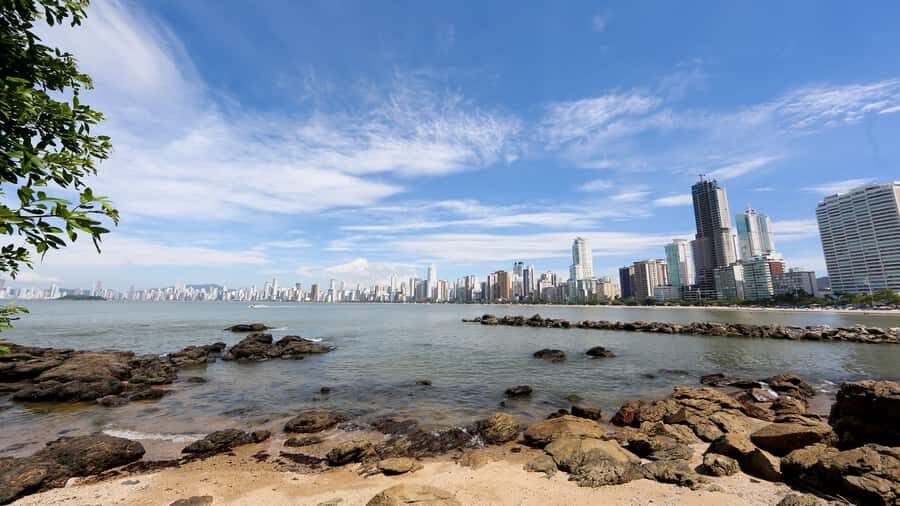
The day starts with classic Santos orientation: you get a look at the restored historic center, then you head along the waterfront strip where the city’s beach vibe becomes the main character. The centerpiece here is the Beach Garden, a famous, carefully maintained promenade lined with flowers and treated trees.
What makes this worth your time is how it helps you understand Santos. This isn’t just “a beach town.” The city is organized around that wide, flat, continuous shoreline. When you see it from the route and then later on a bit of walking time, you get why locals and visitors still come back for the long, easy strolling feel.
And yes, there’s a fun detail to remember when you’re there: this Beach Garden is listed in the Book of Records for its length, stretching about 5,335 meters. Even if you only catch a chunk of it, it’s a neat mental marker, especially if you like when place names actually match what you see.
You can also read our reviews of more tours and experiences in Santos.



Porchat Island: Niemeyer’s monument viewpoint and port horizons
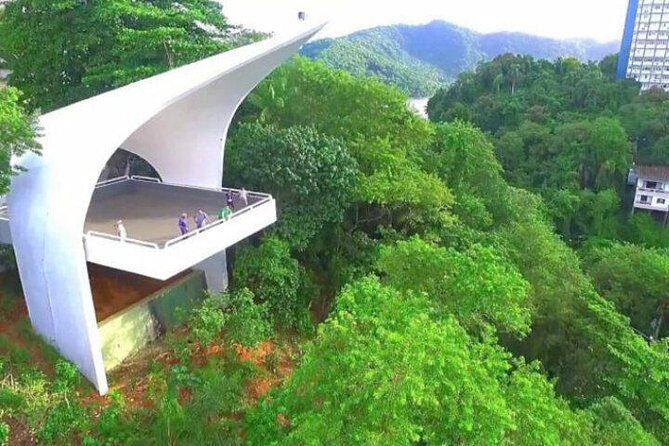
Next comes a viewpoint stop that feels like a map coming to life. Porchat Island rises above the coastline, and the stop is built around the view from the top—specifically near Niemeyer’s monument—looking back toward Santos and out toward ships on the horizon.
This is the moment when the big scale of Santos clicks. You see waves forming, you spot boats out in the distance, and the shoreline looks like a continuous ribbon rather than a handful of separate beaches. Even if your time here is brief, you end up with that “now I get it” perspective that makes the rest of the day easier to follow.
If you’re sensitive to glare, bring sunglasses. Coastal light can be intense, especially around late morning. And if it’s windy, a light layer helps too—you’ll be standing still for photos.
Orquidário Municipal: the urban tropical forest walk that surprises people
Orquidário Municipal is one of the stops that tends to earn real smiles because it breaks the usual “city tour” pattern. You’re in the Zoobotanic Park space, and you walk through a tropical setting that feels far more alive than a typical roadside attraction.
The park includes almost 500 animals across about 70 species, and part of what makes it feel fun for different ages is that you may see animals in ways that feel more natural. The park also has indoor areas focused on birds, where birds land very close to people—so it’s not just a far-away viewing situation.
You also get plant variety and a “garden brain” experience: around 1,500 trees and shrubs plus a sensory-style setup that includes tropical rainforest pathways. There’s even a connection to the symbol of Brazil in the park’s collection, including the Brazil-wood tree that gives the country its name.
One practical note: you’ll want comfortable shoes. It’s a walk through mixed terrain—easy enough, but not the kind of place where flip-flops are a good idea if you don’t want to think about it.
Lunch time on your own: how to use that hour best
Lunch isn’t included, but the tour gives you a solid one-hour lunch window. That’s actually useful. It means you can pick something that fits your appetite and budget instead of being stuck with a set menu you don’t love.
You’ll also notice the lineup of what you can choose is broad in the area—seafood, barbecue, and Brazilian favorites. If you want to play it smart, aim to be seated quickly and eat first, then take a slower look after. In a day like this, the main risk is eating too late and getting rushed at the next stop.
If the group is hungry, your guide may point you toward a good option (in at least one real day, the guide helped people find a local place and even suggested multiple lunch styles). So treat lunch like part of the tour, not a separate chore.
Monte Serrat: funicular ride up, panorama down, chapel built in 1603
Monte Serrat is where the tour turns scenic in a big way. You ride up via a funicular system, and the top area is served by a tram approach from the hill area. The key here is the view: from the viewpoint at the former old casino location, you can look over the port, urban Santos, and the surrounding bay area—plus islands and water channels in the distance.
If you only remember one thing from this stop, make it this: Monte Serrat shows the relationship between Santos’s city and its water. The port isn’t an abstract idea anymore. It becomes a visible working system with channels and island edges.
There’s also the Chapel of Our Lady of Monte Serrat, tied to the city and dating back to 1603. Even if churches aren’t your main interest, it’s worth stepping in because it’s part of why Monte Serrat is more than just a photo platform.
Timing matters here. Your time is limited, and the funicular can build queues at busy times. In at least one instance, a guide rescheduled a visit after spotting a long wait, which is a good reminder: if there’s a line, ask what the plan is. Guides here seem to manage timing to protect the value of the day.

Museu Pelé: football glory, but grounded in Santos
Pelé’s story belongs to Brazil, but Santos is where it has local roots. The Pelé museum is set up as a history track of his achievements, including major prizes and coverage of the World Cups he won, with photos, video footage, and a life timeline.
What I like about this stop is how it adds culture without requiring you to understand sports jargon. You don’t need to be a superfan. The museum frames football as a narrative of a person connected to the city, and you walk out knowing why Pelé and Santos are linked in people’s minds.
Your museum time is around 30 minutes. That’s enough to get the story beats without feeling trapped in a full afternoon. If you’re traveling with someone who wants more museum time, you might be grateful for a shorter format—then you can return later on your own if you want deeper details.
Valongo Sanctuary + Coffee Museum: from old faith to the smell of Brazilian coffee
Santos has religious architecture that’s easy to miss if your route is too beach-focused. The Sanctuary of St. Anthony of Valongo dates to 1640, making it one of the oldest churches in town. You’ll see colorful, detailed decoration, and even if you only have a short visit, it’s a strong contrast to the modern port view from earlier.
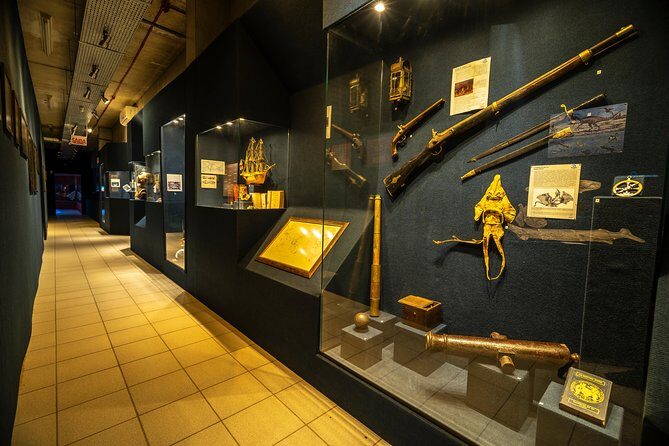
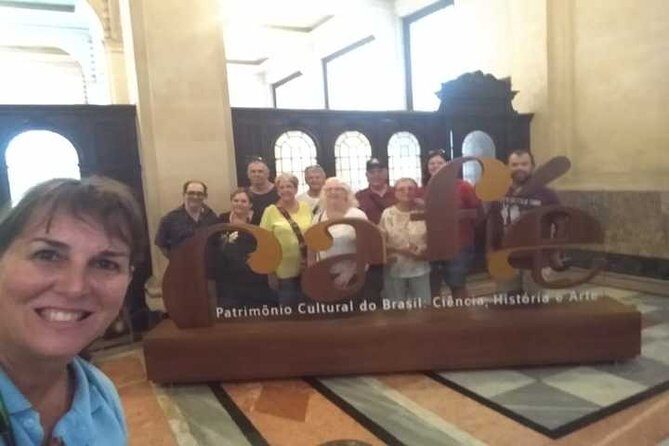
Then comes the Coffee Museum, and this is the kind of stop that feels hands-on. The building is imposing and has the feel of its old role as the Santos Stock Exchange, opened in 1922. The museum explains coffee’s importance to Brazilian socio-economic development.
The standout practical experience is the tasting and aroma side. The coffee shop experience lets you sample different types and smell aromas of coffees ground right before drinking. If you like food and drink travel, this is the moment you’ll actually remember with your senses, not just your camera roll.
It’s also a good end-cap for the day because it’s warm, indoor, and easy to slow down for a little. And if the weather is bad, it saves your schedule. On rainy days, guides can shuffle the day to keep it rain-friendly, and coffee is a solid place to land.
Your 7-hour time budget: what fits, what doesn’t
This tour is designed for breadth in one day. You get city orientation, viewpoints, one zoobotanical walk, two major museums, and a historic church—all with included tickets for the key attractions.
The tradeoff is that most stops are short blocks. That’s why the experience works best if you’re the type who wants a smart overview with a few great moments, not a slow soak in one place.
If you’re thinking of skipping lunch or doing lunch fast, you should still plan to eat something light. The tour covers a lot of walking within stops, plus you’ll be on and off transport repeatedly.
Also, group size matters. With a maximum of 15, you avoid the worst bottlenecks, but you still need to be ready to move as the guide calls it. Bring patience for queues at funicular or indoor lines, especially if you’re traveling during a busy period.
Price and value: is $89 a fair deal for this Santos mix?
At $89 per person for about 7 hours, the value comes from a few things that aren’t just “nice to have.”
First, most key attraction tickets are included, including admissions for stops like Orquidário Municipal, Monte Serrat, the Pelé museum, the Valongo sanctuary, and the Coffee Museum. That matters because it reduces decision fatigue and keeps your budget predictable.
Second, you’re paying for local knowledge and coordination: pickup from the Santos Seaport area, a driver-guide, and a route that connects the shoreline, island viewpoints, and museum stops without you needing to figure out logistics.
Third, the small-group cap changes the feel. Even if every stop is shorter than you’d choose alone, you’re less likely to get lost in a massive crowd.
What can lower perceived value is if you arrive hoping for long beach time or lots of free exploring. This is a structured “highlights day,” and it delivers best when you treat it like that.
The guide experience: clear English and timing that protects your day
Guide quality seems to be a major part of what makes this tour work. Names that come up include Gladys, Elaine, Romi/Romilda, Mary, Maria, Norma, and Mary Carmen. Across them, the common thread is effective pacing and making sure people understand what they’re looking at.
There’s also a practical communication angle. In one case, there was an issue with sound clarity inside the van—no microphone and low volume at the back. If you book this and you end up toward the rear, it’s worth asking at pickup if the guide can be heard well where you’re sitting, so you aren’t spending the ride straining.
The good news: some guides have shown a knack for solving problems fast, like moving viewpoint timing around queue lengths or adjusting the route when weather shifts.
Who should book this Santos shared group tour?
This is a strong match if you want:
- a first visit to Santos and you don’t want to plan a day yourself
- a mix of port-and-coast viewpoints plus museums
- a day with included tickets and pickup so you can show up and go
- a trip style where you’re okay with short stops in exchange for seeing more total highlights
It’s less ideal if you want one or two places only and deep time in each. Also, if you’re extremely sensitive to audio issues on group transport, you’ll want to sit closer to the guide when possible.
Should you book this Santos tour?
If your goal is a well-paced highlights day that starts at the seaport and strings together viewpoints, walking, and culture, I’d say yes. The included tickets plus the Monte Serrat panorama and the coffee tasting make it feel like more than a simple bus loop.
If you’re the type who dreams about a long beach reset, treat this as your intro day, not your full beach day. You’ll get views and a taste of the Beach Garden promenade, but you won’t get a long beach lounge session.
My best advice: book it if you want orientation and memorable stops without hassle. Then, later in your trip, come back on your own for the parts that call you back.
FAQ
What’s included in the 7-hour Santos tour?
Tickets for the attractions are included, along with VAT/taxes, parking during stops, and pickup with transport by fully-equipped vehicles. You also get a licensed bilingual private tour guide.
Is lunch included?
No. Lunch is listed as lunch time and is not included. You’ll have about one hour for lunch.
How big is the group?
The tour is shared, with a maximum of 15 travelers.
Where does the tour start and what time does it begin?
It starts at the Maritime Passenger Terminal – Giusfredo SantiniArmazém 25 Interno do Porto de Santos, with a start time of 9:30 am. It ends back at the meeting point.
How long is the tour?
The duration is about 7 hours (approx.).
What happens if it rains?
While the itinerary is fixed by stops, guides can adjust the plan to keep the day workable in bad weather, as shown by at least one rainy-day experience where the guide switched to rain-friendlier options.