REVIEW · BRASILIA
Bike Tour of the 4 Scales of Lucio
Book on Viator →Operated by Camelo Bike Tour · Bookable on Viator
Four scales of Lúcio Costa, by bike. This is a 7-hour way to see Brasília’s design logic in real scale, from the TV tower area to the core of power. I especially like how the tour mixes big monuments with day-to-day culture, and I also like the free admission stops that let you spend your money on the ride, not tickets.
Second, I love the “on purpose” pacing: you’re not stuck in a bus line or bouncing along crowded sidewalks. You glide through residential and civic zones, which makes the city’s grid and superquadra layout feel practical instead of abstract. That same structure helps if you want to understand Brasília beyond the postcard landmarks.
One consideration: the bikes are generally part of the experience, but fit can be an issue for shorter riders, and the tour runs long enough that you may end up riding into evening if the pace shifts.
In This Review
- Key Things You’ll Notice on This Ride
- Why Brasília Makes Sense on a Bicycle
- The Route Starts With a View (Torre de Televisão)
- Niemeyer’s Choro Connection at Clube do Choro
- Ulysses Guimarães Convention Center: Modern Scale and Real Function
- Sarah Kubitschek Park and Renato Russo Hall
- Learning the Superquadra at SQS 308 (The Model Court Idea)
- The Igrejinha de Fátima: Residential Sector Faith, with Art Tiles
- Superquadra Sul 302 and the Residential Scale Reality Check
- Palácio Itamaraty, Then the Sacred and Monumental Chain
- Rua das Farmácias and Praça do Povo: Small City Life in a Big Plan
- Museums and the South Commercial Sector’s Real Energy
- Human-Scale Health Architecture: Sarah Hospitals Network
- Three Powers Square: The Heart of the Axis
- National Library, Congresso Axis, Pantheon, and Burle Marx Garden
- What Guides Do That Changes the Whole Experience
- Timing, Comfort, and the Evening Factor
- Price and Value: What $97.03 Actually Buys
- Who This Bike Tour Suits Best
- Should You Book This Tour?
- FAQ
- How long is the Bike Tour of the 4 Scales of Lucio?
- How much does the tour cost?
- What’s included with the ticket?
- Are entrance tickets included?
- Is it good for families with children?
- Where does the tour start and end?
- What if the weather isn’t good?
Key Things You’ll Notice on This Ride

- A clear Lúcio Costa lesson plan: superquadras, parks, churches, and the civic center all connect.
- Free entry at every main stop, so the cost is mostly about getting around.
- Max group size of 15, which keeps movement manageable for a city built for long distances.
- Real cultural stops, including the Clube do Choro music school tied to Brazil’s choro tradition.
- Architecture at human speed: you see buildings from angles you miss on foot or by car.
- Strong guide behavior on traffic crossings, including attention to semaphores and safe navigation.
Why Brasília Makes Sense on a Bicycle
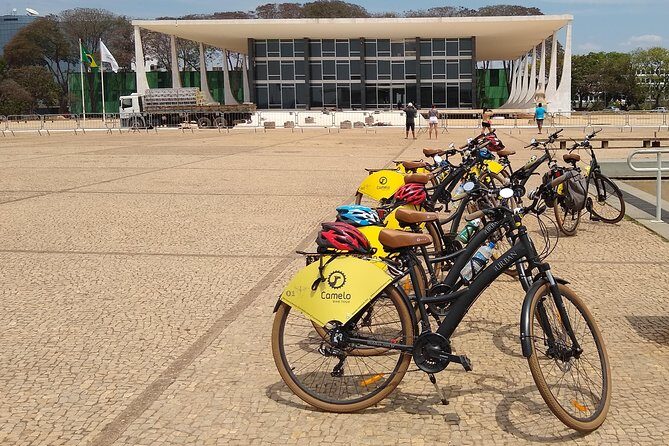
Brasília was designed as a system. That’s the good news for you. Instead of hunting for sights one by one, you follow a logic: parks and superquadras in the residential zones, then the monumental axis for the national institutions. On a bicycle, that “system” clicks fast, because you’re traveling at a speed where buildings stay in view but you’re still moving enough to cover serious ground.
This is also a city where car travel can feel like staring through a windshield. Here, you get to feel the open space, the long sight lines, and the way public areas are shaped for people. The tour leans into that. It’s architecture plus the city’s layout, taught through the ride itself.
Finally, you’ll appreciate the basic comfort setup. You get two bottles of mineral water and a helmet is offered (helmet use isn’t mandatory in Brazil, but it’s there if you want it). For a city where sun and heat can feel immediate, having water ready is not a small detail.
You can also read our reviews of more cycling tours in Brasilia

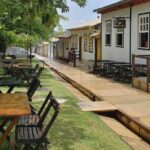
The Route Starts With a View (Torre de Televisão)
Your day begins at the Camelo Bike Tour meeting point in Asa Sul, then you roll to Torre de Televisão at the pilotis. This is a strong first stop because it gives you a quick “map in your head.” Even if you don’t go inside for long, the tower area helps you understand how Brasília puts major landmarks on display.
What makes this start practical is the timing and flow. You’re not negotiating a complicated schedule early on. You get oriented, you settle into the bikes, and then you head to the next zone.
You’ll also pass by the TV tower craft fair. Even if you don’t plan to buy anything, it’s a good snapshot of the local street-art-and-handmade culture that often sits around major landmarks.
Niemeyer’s Choro Connection at Clube do Choro
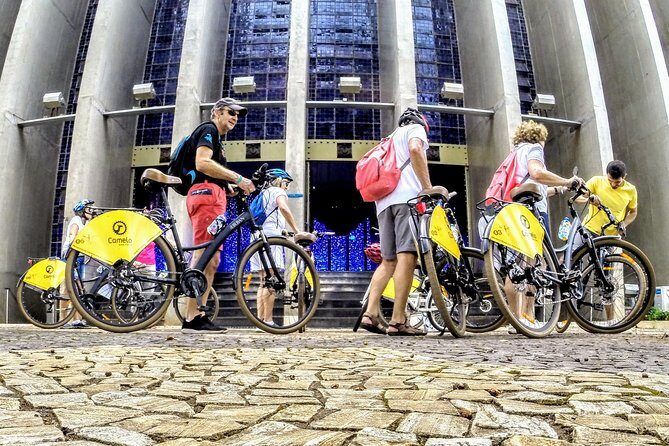
After the tower area, the tour moves to Clube do Choro, one of the city’s notable Niemeyer cultural projects. This hall is for roughly 500 people and serves as a concert space plus a music school.
The detail I liked here is that it isn’t just a building you take pictures of. It’s tied to education and daily practice. The school teaches a broad range of instruments associated with choro and Brazilian music—everything from cavaquinho and mandolin to saxophone and accordion.
There’s also a memorable modern moment connected to the venue: after Paul McCartney’s surprise, intimate show on November 28, 2023, the stage gained a special status. The point for you isn’t celebrity trivia—it’s the way this hall connects Brasília to the world while still serving local musicians and students.
Ulysses Guimarães Convention Center: Modern Scale and Real Function
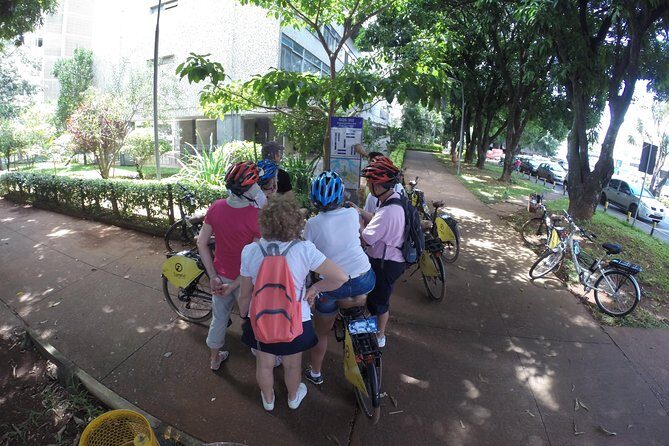
Next up is the Ulysses Guimarães Convention Center, described as one of Brazil’s most modern facilities. It’s built for big simultaneous capacity, with a large total area and multiple auditoriums and modular meeting rooms.
This stop is valuable for understanding Brasília’s ambition. Brasília isn’t only about government. It’s also about events, conferences, and public gatherings. The convention center sits close to major government headquarters and major hotels, so you’re seeing how the city supports big institutional needs at scale.
If you’re the kind of traveler who loves “how it works” details, you’ll enjoy how the stop emphasizes planning and capacity, not only architecture.
Sarah Kubitschek Park and Renato Russo Hall

Then you ride into Parque da Cidade Sarah Kubitschek, often described as one of the largest urban parks in the world. On a bike, parks like this feel like a reset button—space for your eyes and a break from the monumental buildings.
From there, you head toward Renato Russo Hall, another cultural stop that fits the tour’s theme: Brasília isn’t just ministries and statues. It has a strong creative scene, and music and performance spaces matter here.

Learning the Superquadra at SQS 308 (The Model Court Idea)
One of the tour’s most “aha” moments is SQS 308 in Asa Sul. This is the model court concept: Lúcio Costa designed it, Burle Marx handled the urbanism and landscaping, and Banco do Brasil built it. It was inaugurated on February 19, 1962.
Why you should care: superquadras can sound like a jargon word until you see them in real neighborhoods. This spot links the plan’s ideas—how buildings, lots, schools, shops, and leisure spaces fit together. It’s the city’s everyday life made visible.
If you take one thing from the tour, take this. The residential scale is part of Brasília’s architecture story, not an afterthought.
The Igrejinha de Fátima: Residential Sector Faith, with Art Tiles
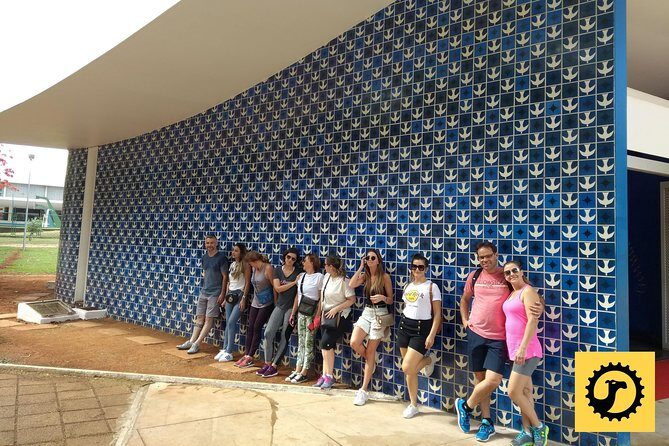
You’ll also visit Igrejinha Nossa Senhora de Fátima, inaugurated in June 1958. It was the first church located in the residential sector, created at the request of Dona Sarah Kubitschek, linked to a grace related to the cure of her daughter.
This church has an art detail you’ll actually see: Athos Bulcão tiles line the outer walls with stylized figures of the Dove of the Divine and the Star of the Nativity. That’s the kind of crafted specificity that makes modernist Brasília feel human rather than sterile.
Superquadra Sul 302 and the Residential Scale Reality Check
The tour continues through Superquadra Sul 302, described as a key example of Brasília’s residential scale. You’re not just repeating the model idea; you’re comparing configurations. It’s not the first superquadra, but it offers similar planning principles through building projections, local shops, schools, and leisure areas.
For you, this matters because it helps you stop seeing Brasília as a single designed postcard. You see how the blueprint becomes multiple neighborhoods.
Palácio Itamaraty, Then the Sacred and Monumental Chain
In the civic-and-institutional sequence, you’ll pass Palácio Itamaraty, a Niemeyer landmark known as Palácio dos Arcos. Then you head to Santuario São João Bosco, built for the city’s patron saint.
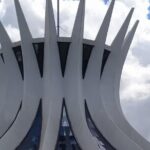
After that comes the spiritual mega-icon: Catedral Metropolitana, authored by Oscar Niemeyer. The tour frames it as a milestone in modern architecture and in Brasília’s history. I like seeing the cathedral here because it sits in a logical chain: residential life, then cultural life, then sacred monument, then power and government.
If you’re thinking about your photos, do it with patience. These buildings reward different angles, and the bike movement helps you get those without walking back and forth.
Rua das Farmácias and Praça do Povo: Small City Life in a Big Plan
After the monumental stops, you’ll ride past Rua das Farmácias, a commerce-heavy street tied to the nearby South Medical and Hospital Sector. This is one of those small details that makes the bigger plan feel lived-in.
Then you reach Praça do Povo in the South Commercial Sector (SCS). It was renovated in 2021, and the project received awards from the Instituto de Arquitetos do Brasil (IAB) in urbanism and planning categories. The renovation is set up for real multifunction use: skateboarding, shows, kiosks, and public gathering.
This stop is a reminder that Brasília’s “empty space” reputation ignores how people actually use these zones.
Museums and the South Commercial Sector’s Real Energy
You’ll also visit the Museu Nacional da República area, planned in Brasília’s original plan. It’s part of a cultural complex connected to an Oscar Niemeyer project commissioned in the 1970s.
Then comes Setor Comercial Sul, described as a central pedestrian flow area during weekdays, supported by bus connections and proximity to the Esplanade dos Ministérios. The tour emphasizes how revitalization has brought important architecture into the area too, including works linked to Oscar Niemeyer and Lelé.
One of the practical bonuses here: this section helps you feel the city’s rhythm. It’s not just institutions. People are moving, services are running, and the city has commerce and culture.
Human-Scale Health Architecture: Sarah Hospitals Network
You’ll pass the first unit of the Sarah Hospitals Network, focusing on a rehabilitation center for locomotion and orthopedic diseases. The tour’s description makes it clear that this is architecture with a purpose beyond aesthetics—humanized spaces, airy environments, natural ventilation and lighting, and a rationalized construction system for flexibility.
The mention of Lelé, João da Gama Filgueiras Lima, is especially relevant. If you care about construction method and details, this is one of those stops where you can see how Brazilian modernism can be practical. It’s not a monument you admire from far away; it’s a building that’s meant for long stays and recovery.
Three Powers Square: The Heart of the Axis
Now you enter the big civic sequence. You’ll ride to Praça dos Três Poderes, inaugurated in April 1960, created by Lúcio Costa and designed by Oscar Niemeyer. This is the civic space that frames Brasília’s identity: government power, monumental scale, and the Esplanade’s long perspective.
Then you’ll visit Espaço Lúcio Costa, an underground construction opened in 1992 for Lucio Costa’s 90th anniversary. It houses models of the Brasília plan and tactile planning elements.
After that, you’ll pass by key institutions including the Supremo Tribunal Federal and the Claudio Santoro National Theatre (National Theatre). You’ll also ride past cultural spots along the way, including Cultura Inglesa, Aliança Francesa, and Praça 21 de Abril.
The tour’s narrative thread matters here. It’s not only “see the buildings.” It’s “see how the plan organizes civic life,” with monuments connected to cultural institutions.
National Library, Congresso Axis, Pantheon, and Burle Marx Garden
The ride includes National Library of Brasília and the area described as the place where the President dispatches. From there, you reach Panteão da Pátria (Pantheon of the Fatherland) and the National Congress, described as the apex landmark at the Three Powers Square beginning of the ministries axis.
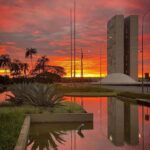
Then you finish the scenic loop with Jardim Burle Marx, followed by the Ministries Esplanade. Burle Marx’s garden concept is one more reminder that landscape here is planned, not random. It’s part of the urban composition.
What Guides Do That Changes the Whole Experience
A bike tour lives or dies by the guide’s control and explanations. The tour’s guides have a reputation for being attentive on the route. I saw this in the way guide names came up across different experiences—Larissa, Romain, Rui, and Daniel—with praise for clear direction, entertaining explanations, and handling intersections and semaphores.
In plain terms: you don’t want to spend your day worrying about traffic flow. You want someone who knows how to guide a group through wide intersections and keep everyone moving at a safe, comfortable pace. If you get that, the architecture becomes the focus instead of the logistics.
Also, a heads-up from real feedback: the bikes can vary. One rider felt the bikes could be in better shape. Another mentioned a challenge finding the right fit for two short women. So if you’re on the shorter side or your fit matters a lot, it’s worth arriving ready to spend a few minutes on adjustments.
Timing, Comfort, and the Evening Factor
This tour runs about 7 hours. That’s long enough that you may ride into evening depending on pacing and conditions. One useful note: there was a suggestion about visibility (lights for helmets or bikes) during evening segments. The operator indicated lights exist for nighttime tours, but timing can sometimes stretch.
So practical advice:
- Bring a light layer for later in the day.
- If you think you’ll be out after sunset, ask at the start how lights are handled for helmets/bikes.
- Wear sun protection. Brasília sun can feel relentless even when the route seems wide open.
Price and Value: What $97.03 Actually Buys
At $97.03 per person, this tour is priced like a “guided architecture day” rather than a basic transport service. The best value points are the inclusions and the structure:
- Bicycle included
- Helmet offered
- Two bottles of mineral water
- Admission tickets are free at the listed major stops
That combination matters. Many architecture tours charge extra for entry. Here, you’re mostly paying for time, route planning, and guiding. You’re also getting a way to reach places efficiently in a city where distances are part of the design.
If you’re coming for Brasília’s architecture and you want a day where the route makes sense, the price feels fair. If you’re only interested in a single monument, you might find a shorter option more efficient—but this is built for people who want the full Lúcio Costa story arc.
Who This Bike Tour Suits Best
This tour is a great match if you:
- Want a city-logic experience, not just a checklist
- Like architecture, but also want cultural stops and everyday planning
- Prefer moving under your own power instead of being stuck in a vehicle
It also works for most travelers. The operator can provide an articulated tandem passenger trailer for kids aged 4 to 10 / 12 if you ask in advance.
Should You Book This Tour?
Yes, I’d book it if you’re trying to understand Brasília’s plan in one day. The itinerary connects residential superquadra ideas with culture and then ramps up to the civic core in a way that’s easier to grasp from the saddle.
Skip or consider a different length if:
- You need a very flexible pace with frequent rest stops.
- Bike fit is a big concern for you and you don’t want to spend time adjusting at the start.
- You only care about a couple of the most famous monuments.
If you come with curiosity and a willingness to ride, this tour gives you a coherent map of Brasília’s thinking—Lúcio Costa’s scales, Oscar Niemeyer’s forms, and Burle Marx’s planning choices—without making you pay for a stack of tickets.
FAQ
How long is the Bike Tour of the 4 Scales of Lucio?
It’s listed as about 7 hours.
How much does the tour cost?
The price is $97.03 per person.
What’s included with the ticket?
You get bicycle use, two bottles of mineral water (500ml each), and a helmet is offered.
Are entrance tickets included?
The tour description notes admission tickets as free for the listed stops.
Is it good for families with children?
There is an articulated tandem passenger trailer available for children from 4 to 10/12 years old if you ask in advance.
Where does the tour start and end?
It starts at Camelo Bike Tour Brasília in Asa Sul (SHS Quadra 06 Conjunto A, Bloco A, Loja 17, Centro Empresarial Brasil 21) and ends back at the same meeting point.
What if the weather isn’t good?
This experience requires good weather. If it’s canceled due to poor weather, you’ll be offered a different date or a full refund.