REVIEW · RIO DE JANEIRO
Bossa Nova Walking Tour
Book on Viator →Operated by Rio Bossa Experience · Bookable on Viator
Bossa Nova sounds better when you walk it. This 3-hour stroll in Rio pairs a live guitar performance with a guide who explains how each stop connects to the Brazilian sound—so you’re not just hearing about music, you’re hearing it where it belongs. I love the way the tour turns landmarks into cues for songs and stories, and the guitarist keeps the mood moving instead of pausing for lectures.
My other favorite part is the small-group feel: it caps at 8 people, so Gui Guimares (and other guides like Guilherme, as referenced in feedback) can pace things to the group. One consideration: the tour includes the guide and guitar, but transport and food/drinks/water are not included, so plan to start hydrated and ready to walk.
In This Review
- Key highlights you’ll care about
- A Bossa Nova tour you can actually listen to on the move
- Timing, group size, and what to wear for a 3-hour stroll
- Meeting point in Ipanema: where to start and how to finish your walk
- Stop 1: Praca Nossa Senhora da Paz and the opening guitar talk
- Stop 2: Praca General Osorio and the Hippie Fair connection
- Stop 3: Copacabana Beach and why the setting matters
- Stop 4: Dorival Caymmi’s statue and the Bahia thread
- Stop 5: Parque Garota de Ipanema and the Girlfriend story
- Stop 6: Estatua de Tom Jobim and the composer moment
- Stop 7: Casa de Cultura Laura Alvim and the cultural link
- Price: what $48.03 gets you (and why it can feel fair)
- What you’ll take away after the walk
- Who this tour suits best
- Should you book it? My practical call
- FAQ
- FAQ
- How long is the Bossa Nova Walking Tour?
- What does the tour cost?
- How many people are in the group?
- What’s included in the price?
- What’s not included?
- Where do you meet, and where does it end?
- Are there admission fees for the stops?
- Does the tour run in bad weather?
- Are service animals allowed, and can most travelers participate?
- What’s the cancellation and confirmation process?
Key highlights you’ll care about

- Live guitar at every stop so the music lands right when the story connects.
- Max 8 travelers for a more personal pace than bigger city tours.
- Interactive storytelling style that feels like you’re joining the music, not sitting through a slideshow.
- Icon landmarks in Ipanema and Copacabana tied to the Bossa Nova/samba conversation.
- Free admission for the stops (no extra ticket costs at each location).
A Bossa Nova tour you can actually listen to on the move
This is one of those tours where the format does half the work for you. You walk through Ipanema and nearby areas for about 3 hours, and at each planned stop the guide and guitarist bring the sound into the street. That matters because Bossa Nova is not just music to read about—it’s music shaped by place, rhythm, and attitude.
I also like the balance here. The tour isn’t only “facts and dates.” You get a mix of context about Brazilian music, plus the guitar performance that keeps the energy steady. Even if you’re not a hardcore music nerd, the guide’s job is to connect the dots in a way you can feel.
You can also read our reviews of more walking tours in Rio de Janeiro



Timing, group size, and what to wear for a 3-hour stroll
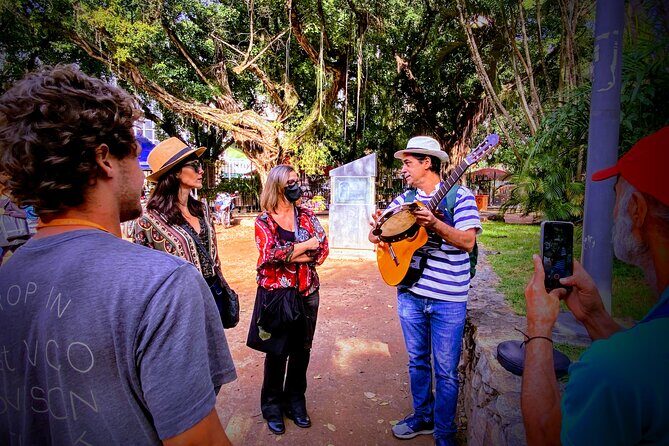
Expect an easy walking rhythm rather than a sprint. The experience is listed at about 3 hours, and it runs in good weather because that’s when the outdoors format works best. The group stays small (maximum of 8), which usually means less waiting around and more time with the guide.
For comfort, wear shoes you can stand and walk in for a while. You’re outdoors most of the time, and you’re also skipping transport because it’s not included. Bring sun protection if it’s bright, and keep a small plan for water since you won’t have food/drinks provided.
Meeting point in Ipanema: where to start and how to finish your walk
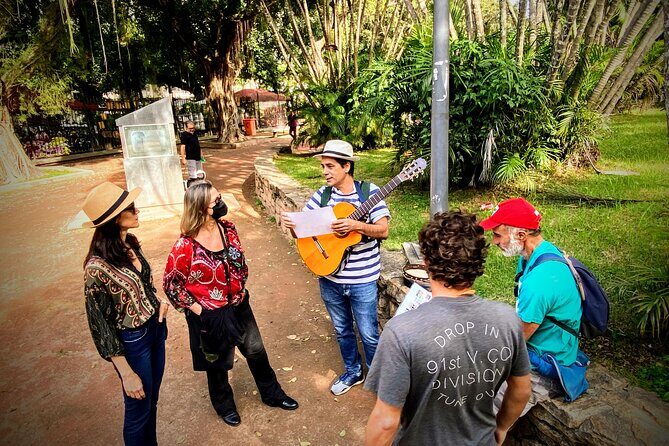
The tour starts at Nossa Senhora da Paz / Ipanema (Ipanema, Rio de Janeiro). You’ll end at Restaurante e Bar Garota de Ipanema, at R. Vinícius de Moraes, 49, with the note that it’s on the corner of Vinicius de Moraes and Prudente de Morais.
This end point is handy. It puts you back in Ipanema, where you can keep exploring afterward without needing to re-orient yourself from scratch. And because it’s near public transportation, you can also head out easily if you don’t want to linger.
Stop 1: Praca Nossa Senhora da Paz and the opening guitar talk
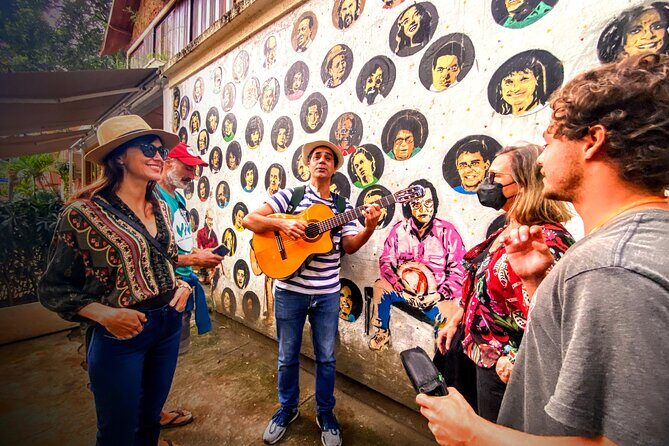
The tour begins at Praca Nossa Senhora da Paz, where you get a welcome talk and a briefing on what you’ll hear and why it matters. The guide sets the foundation by explaining Brazilian music history and then plays with live guitar.
What I like about the opening is that it gives you a mental hook before you start moving. It’s not just, here’s a song—it’s, here’s what to listen for as you go from place to place. Admission is listed as free here, too, so you’re not distracted by extra logistics.
Stop 2: Praca General Osorio and the Hippie Fair connection
Next up: Praca General Osorio. This stop focuses on the Hippie Fair and how it connects to the Bossa Nova moment, with another live guitar performance.
The practical value of this stop is that it widens the lens. Bossa Nova didn’t appear in a vacuum. The guide frames it in relation to the kind of culture that was happening around it, and then you hear the sound again while you’re standing in the story’s setting. Admission is free here as well, so it stays simple.
If you care about atmosphere, this is a good place to notice the energy around the plaza and think about why music scenes often grow in public spaces.





Stop 3: Copacabana Beach and why the setting matters
Then you reach Copacabana Beach, and the tour explains how Copacabana was important for the Bossa Nova movement. You get a fresh bit of context and another guitar performance.
Copacabana can be a lot visually, but this stop keeps you focused by tying what you see to what you listen for. You’re not only taking in the coastline; you’re hearing how the guide wants you to interpret the place. Admission is free at this stop too, so the only real “cost” is your time and energy.
Tip: if the sun is strong, Copacabana can feel hotter than you expect. Plan for a slower pace for a few minutes so the walking doesn’t turn into a sweat sprint.
Stop 4: Dorival Caymmi’s statue and the Bahia thread
At Estatua de Dorival Caymmi, the tour shifts toward Bahia and how its music relates to Bossa Nova. The guide uses live guitar again here to connect the sound to the composer being highlighted.
I like this stop because it helps you understand influence. Even if Bossa Nova is often discussed as its own style, the tour treats it as part of a wider Brazilian musical conversation. Dorival Caymmi is presented through that Bahia connection, and the guitar makes the relationship feel less abstract.
Also, the stop length is about 20 minutes, which is just enough time for explanation without dragging.
Stop 5: Parque Garota de Ipanema and the Girlfriend story
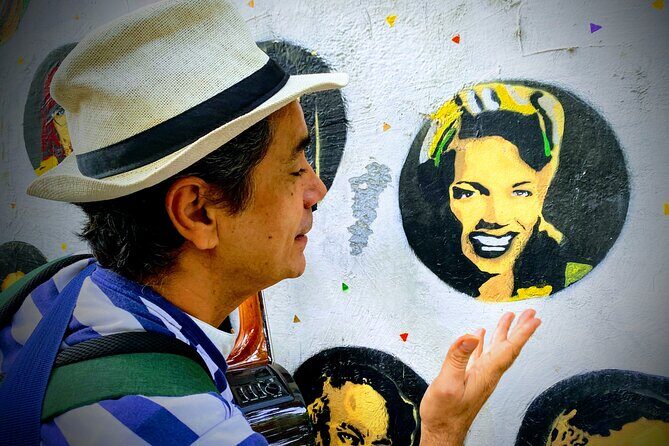
At Parque Garota de Ipanema, you learn about who the Girlfriend from Ipanema is, followed by another live guitar performance. This is one of the more story-driven stops, and it fits the Ipanema setting in a way that feels natural rather than forced.
If you’re the type who likes your music tied to real people and places, you’ll probably enjoy this. It gives you a human anchor while you’re in the neighborhood most associated with the imagery.
One small practical note: the tour keeps multiple stops tightly scheduled. So if you’re the kind of person who likes to linger for photos, keep an eye on the group pace.
Stop 6: Estatua de Tom Jobim and the composer moment
Next is Estatua de Tom Jobim. The tour explains Antonio Carlos Jobim and pairs the talk with live guitar.
This is the “core name” stop, and it matters because Jobim is tied to the identity of the sound the tour is chasing. What makes it valuable in practice is that you’re hearing music while learning the who/why—not only absorbing information.
In the feedback, the guitarist is praised for playing classics as part of the tour experience. One review even mentions the guitar as being made in Grenada, Spain. That kind of detail might not change your travel plans, but it’s a good sign that the music component is taken seriously.
Stop 7: Casa de Cultura Laura Alvim and the cultural link
The final stop is Casa de Cultura Laura Alvim, where you learn about Laura Alvim and why she’s important to Brazilian culture and music. Live guitar continues here as well, with about 15 minutes allocated for this wrap-up.
I like ending with a cultural figure rather than another statue. It shifts you from street-level landmarks into a broader sense of cultural life. You’ll finish with a clearer idea that Bossa Nova is not just a sound—it’s supported by people, venues, and a wider cultural ecosystem.
Price: what $48.03 gets you (and why it can feel fair)
The tour costs $48.03 per person for roughly 3 hours. What you’re paying for is not an entry-ticket tour. You’re paying for a guided walk plus a guitarist who performs live during the explanation. Stops are listed as admission ticket free, so your money goes toward the human experience and the music.
Given the max group size of 8, the price also feels more reasonable than tours that pack in larger groups and replace live music with a recording. If you’re comparing value, focus on the combination: guide + live performance + walking route that ties it all together.
One more thing: it’s often booked about 23 days in advance on average, which is a signal that the format is popular and small-group capacity can fill.
What you’ll take away after the walk
This tour works best if you like connecting sound to context. You’ll end with a set of “listening landmarks,” where you can remember which stop corresponded to which musical idea. Even if you don’t know Bossa Nova already, the tour structure helps your brain organize it: you hear, you walk, you learn, you hear again.
And because the guide-and-guitar format is praised for feeling participatory—more joining than lecturing—it tends to keep attention from wandering. That’s a big deal on a vacation day.
Who this tour suits best
This is a great match if:
- You want live music in public spaces instead of a museum-style presentation.
- You’re curious about Bossa Nova, samba, and the broader Brazilian music scene but don’t want a heavy academic feel.
- You like small groups and steady pacing over big bus-tour energy.
It might be less ideal if:
- You hate walking outdoors for 3 hours.
- You want transport included or you expect food/snacks.
Should you book it? My practical call
Book this tour if you like the idea of hearing music where the story points you. The live guitar at every stop is the heart of it, and the small group size helps the guide keep things moving at a human pace. Also, the fact that multiple stops are free of admission fees keeps it from feeling like you’re paying extra on the side.
If you’re on a tight schedule, check your comfort with walking. But if you can do the stroll, this is one of the better ways to experience Rio music culture without turning your day into a list of tourist checks.
FAQ
FAQ
How long is the Bossa Nova Walking Tour?
The tour lasts about 3 hours.
What does the tour cost?
It costs $48.03 per person.
How many people are in the group?
The tour has a maximum of 8 travelers.
What’s included in the price?
You get a tour guide and live guitar musician performance.
What’s not included?
Transport and food/drinks/water are not included.
Where do you meet, and where does it end?
You meet at Nossa Senhora da Paz / Ipanema. You end at Restaurante e Bar Garota de Ipanema on R. Vinícius de Moraes, 49, at the corner of Vinicius de Moraes and Prudente de Morais.
Are there admission fees for the stops?
The tour lists admission tickets as free at each stop.
Does the tour run in bad weather?
The experience requires good weather, and if it’s canceled due to poor weather, you’ll be offered a different date or a full refund.
Are service animals allowed, and can most travelers participate?
Service animals are allowed, and most travelers can participate.
What’s the cancellation and confirmation process?
You receive confirmation at the time of booking, and you can cancel for a full refund up to 24 hours in advance of the experience start time.